
PVC Pipe Extrusion Screw Barrel: How Screw Design Affects Plasticizing and Pipe Quality
PVC Pipe Extrusion Screw Barrel: How Screw Design Affects Plasticizing and Pipe Quality


Good PVC pipe is not just made with good fusion control. The PVC pipe extrusion screw barrel needs to accurately convey the dry blend, compress and fuse it into pipe, and then feed the die at the correct consistency within the thermal window of the PVC formula. Measuring the pipe, looking at the surface of the pipe, and carrying out specific tests on the product will show whether adequate work has been carried out.
Start with the PVC Formulation and Screw Architecture
Treat Dry Blend Differently from Pellets
PVC powder dry blends containing stabilizers, lubricants, pigments, and calcium carbonate or other fillers are commonly fed to the extruder as a powder dry blend. Because of the packing and wall-friction characteristics of such material, it is vastly different from uniform pellets. The intermeshing counter-rotating screws of the extruder provide a number of confined conveying spaces and try to move the material forward by positive displacement. However, the resulting flow is not necessarily pulse-free and does not result in constant pressure. Record the blend preparation and the feed material consistency before altering any of the extruder geometry.
Distinguish Conical, Parallel, and Counter-Rotating
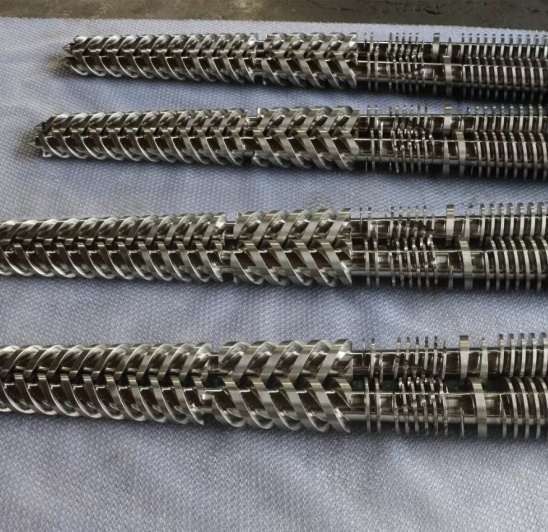
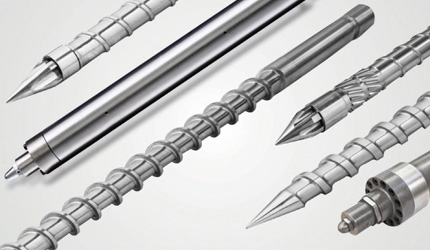
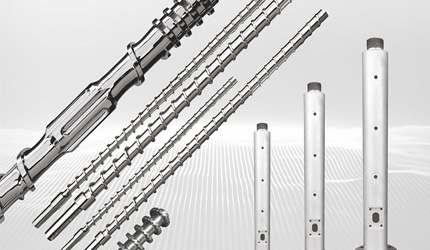
“Counter-rotating” refers to the relative rotation direction. “Conical” refers to a tapered shape. “Parallel” refers to a roughly constant diameter along the processing length. CHUANGRI SCREW refers to conical and parallel twin-screws used for processing PVC and related materials. The choice of screws is largely based on the output required, the formulation to be processed, the presence of fillers, the machine and gearbox used, the screw geometry, the end product, and the die required. Our PVC Pipe Conical Twin-Screw listed here is a component used for processing pipe, and does not imply that a PVC line is of this architecture.
Control Fusion Through the Screw Profile
Balance Conveying and Compression
The feed-region geometry, such as the channel cross-section and wall thickness, capacity, depth, pitch, and compression distribution must match the blend and machine. The same geometry can produce a different load and thermal response after a change to a lubricant or filler, and thus must be designed with the intended formulation and duty in mind. The geometry should be provided with the drawing and tested against the same process task.
Note the locations of the current feed, compression, and discharge areas. Indicate any wear or process anomalies in these areas. Do not attempt to change the drawing under test and the associated formulation at the same time. Even a seemingly satisfactory test run will not enable you to tell whether it was the amendment to the drawing or the new formulation that was effective and whether the original compound is still adequate.
Avoid Both Under-Fusion and Excessive Heat
Rigid PVC material requires a certain amount of mechanical and thermal energy to achieve fusion and homogenisation. An inadequate amount of energy might not ensure complete fusion, whereas over-mechanical work generates extra friction and shear heat, increases melt temperature, and accelerates thermal degradation. A controlled amount of shear in a stable fusion window is what is required, and this fusion window needs to be established with the help of the compound supplier. Pipe qualification tests also need to be fulfilled, and a single temperature for every blend should not be prescribed.
Connect Melt Delivery with Pipe Defects
Investigate Surface and Dimensional Variation
Uniform fusion of rigid PVC pipe requires control of melt temperature as well as consistent die feed. Pipe must also have consistent cross-sectional dimensions and surface quality. While complex dies can have high flow resistance, even uneven flow resistance, upstream stable conveying of material can aid in consistent feeding and filling. Pressure and material output variation must be recorded and correlated with wall thickness measurements as opposed to operator perceptions of pipe quality.
Separate Plasticizing Problems from Downstream Faults
A rough pipe surface is not a diagnosis; it is a reason to investigate fusion, contamination, the die, and calibration. This would include an examination of the fusion, contamination, die, and calibration. For wall variation, centering, haul-off, cooling, and sizing would all need to be checked. Plot the first visible defect against the corresponding melt-pressure measurements. Do not change the inspection points or test methods, or you may confuse a good sample with a good screw design.
Use a diagnostic record with four columns: observed defect, synchronized process trend, inspection finding, and next controlled check. For example, a wall-thickness change without a matching pressure disturbance calls for downstream investigation alongside the melt review. State that relationship as a hypothesis to test rather than proof of a single cause.

Account for Fillers and Progressive Wear
Recheck the Design After Formulation Changes
Calcium carbonate affects dry-blend flow, internal and metal-wall friction, torque, heat generation, plasticization, and abrasive wear. Counter-rotation does not eliminate these effects. Specially designed Pitch, Compression and Channel geometries, as well as wear-prone areas, must match the respective formulation. While we can offer bimetallic, SKD, alloy, and even tungsten-carbide protection, no lifetime guarantee can be given. Comparison the Bimetallic Twin-Screw option with measured wear locations; filler percentage alone is not enough to select it.
Look for Geometry Changes Before Raising Settings
Compare current screw and barrel dimensions to approved drawing using the manufacturer’s measurement method for checking uneven wear as opposed to a single figure for clearance. If previous quality was achieved at lower speed or less demanding thermal conditions, record previous settings in case trends are masked by more aggressive settings and the process window changes.
Specify and Validate the Screw Barrel Pair
Provide the Interfaces and Quality Targets
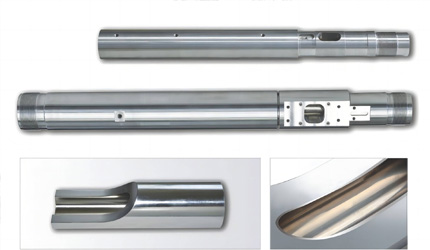
Prepare the request around the actual pipe job: resin system, filler and lubricant package, pipe dimensions, accepted output, die information, gearbox interface, drawing, and measured wear. Specify the PVC Conical Twin-Screw Barrel as part of a compatible pair. Its availability alone says nothing about a guaranteed output, a processing temperature, or compliance with the pipe standard.
Agree on a Repeatable Acceptance Run
Set acceptance criteria before the change: stable output, melt condition, pressure behavior, pipe dimensions, surface quality, and applicable product tests. Keep blend preparation, die, cooling, and haul-off comparable during the trial. Record startup losses and observations through a representative run, then retain the final settings and inspection results as the baseline. If the process fails, isolate feed, fusion, die, and downstream causes in that order rather than changing everything together.
Retain the blend batch identification and the approved settings with the inspection record. Check that dimensional samples represent the whole run, rather than only the moment after adjustment. Any performance test required by the pipe specification remains necessary after a geometry change, even when extrusion looks more stable.
FAQ
Q: What does a PVC pipe extrusion screw barrel control?
A: The action of melt in a pipe influences its conveying, compression, fusion, homogenization, and melt delivery. In addition, pipe quality is affected by the die, pipe sizing, cooling, and haul-off.
Q: Is a conical PVC screw the same as a counter-rotating screw?
A: No. Conical describes a geometric shape. Counter-rotating describes a relationship of rotation. Check the specifications for both terms as well as the machine interface.
Q: Can higher barrel temperature fix poor PVC pipe plasticizing?
A: Additional thermal energy may be required from time to time, but increased temperature cannot compensate for worn nozzles or unstable feedthroat configuration. Verify the actual melt condition and potential for degradation prior to making process changes.
Q: How does calcium carbonate affect a PVC extrusion screw?
A: This changes the factors for conveying, friction, torque, heat, welding, and wear. One design does not fit all different loading situations. Check the full formula and the measured process response.
Q: Which tests confirm that a PVC pipe screw design works?
A: To check for compliance, use agreed output and process-stability criteria and perform relevant dimensional, surface, and pipe-performance tests. Appearance does not necessarily mean adequate fusion or product compliance.

 consult
 WHATSAPP
 leave message
 top