

Screw and Barrel Design: How It Impacts Processing Efficiency
Screw and Barrel Design: How It Impacts Processing Efficiency


Screw and Barrel Design and Its Role in Processing Efficiency
Screw and barrel design play a decisive role in processing efficiency across modern plastic manufacturing. In practical production terms, processing efficiency is not defined by maximum output alone, but by how consistently a system delivers stable throughput, controlled energy consumption, uniform melt quality, and minimal unplanned downtime. When screw geometry and barrel structure are engineered as an integrated system, machines operate within a wider and more forgiving processing window.
As material formulations become more complex, the impact of screw and barrel design on efficiency becomes more visible. Higher filler content, recycled polymers, and tighter quality tolerances amplify the consequences of design mismatch. Under these conditions, efficiency losses cannot be corrected indefinitely through temperature or speed adjustments. Instead, screw and barrel design becomes a primary engineering decision that directly influences production stability and long-term operating cost.
Screw Design Parameters That Influence Processing Efficiency
Screw Geometry Design and Material Conveying Efficiency
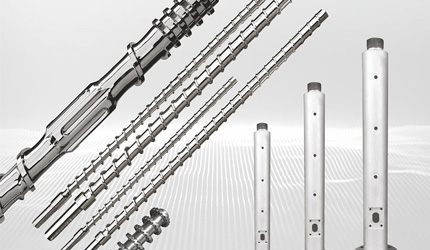
Screw geometry determines how efficiently material is conveyed from the feed zone to the melting section. Parameters such as L/D ratio, flight depth, and pitch control how evenly material advances and how consistently pressure builds along the screw. An overly deep flight may improve feeding for low-bulk-density regrind but can destabilize pressure, while a shallow profile may restrict conveying and force higher torque.
Efficient material conveying reduces corrective energy input. When geometry is properly matched to material behavior, the screw delivers stable output without frequent speed changes or temperature compensation. This stability directly improves energy efficiency per kilogram processed and reduces mechanical stress on the drive system.
Compression Ratio and Melting Zone Design Efficiency
Compression ratio selection shapes melting efficiency and thermal balance. A higher compression ratio accelerates melting but also increases shear heat and torque, narrowing the processing window. Conversely, insufficient compression delays plastication and shifts the thermal burden to barrel heaters, increasing energy consumption.
Balanced melting improves both output stability and component life. A well-designed melting zone achieves complete plastication with controlled shear, allowing the system to maintain throughput without overheating the polymer or accelerating wear.
Mixing Section Design and Melt Homogeneity Control
Mixing section design influences melt uniformity while directly affecting processing efficiency. Static mixers, barrier elements, or specialized mixing zones improve dispersion, but every added element introduces pressure loss and energy demand. The goal is not maximum mixing at all costs, but sufficient homogeneity to meet product requirements.
Targeted mixing preserves efficiency. By placing mixing features only where formulation behavior requires them, designers avoid unnecessary pressure drop and maintain higher effective output, especially in applications involving frequent color or material changes.
Barrel Design Factors Affecting Processing Efficiency
Barrel Bore Accuracy and Friction-Related Efficiency Loss
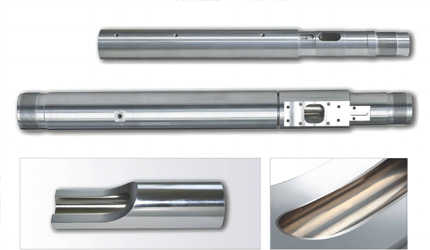
Barrel bore accuracy has a measurable impact on friction-related efficiency loss. Tight dimensional tolerances and low surface roughness reduce drag and leakage flow, allowing pressure to develop efficiently along the screw. As wear progresses, increased clearance leads to higher energy consumption and reduced output consistency.
Wear-resistant barrel design protects long-term efficiency. In demanding environments, solutions such as a Bimetallic Screw and Barrel help preserve bore integrity, slowing efficiency decline, and maintaining stable processing conditions over extended service life.
Thermal Control and Barrel Structure Design Efficiency
Thermal control efficiency depends on barrel structure and zone layout. Uniform heating and responsive cooling prevent localized overheating that forces operators to reduce speed or output. Well-designed heating zones support stable melt temperature with less corrective adjustment.
Structural rigidity supports predictable heat transfer. Straightness and mechanical stability ensure consistent contact between the melt and the barrel, improving thermal response and reducing scrap caused by temperature fluctuation.
Processing Efficiency Differences Across Applications and Materials
Extrusion Processing Efficiency and Screw–Barrel Matching
Extrusion processing efficiency relies on continuous, stable material flow. Unlike batch processes, extrusion demands consistent pressure and temperature profiles over long production runs. Screw–barrel matching is therefore critical to maintaining steady throughput rather than chasing short-term output peaks.
Application-specific components improve efficiency outcomes. For example, a Parallel Twin-Screw Barrel designed for balanced shear distribution supports stable extrusion rates while minimizing energy fluctuation when feed conditions vary.
Injection Molding Processing Efficiency and Cycle Stability
Injection molding efficiency is closely tied to plasticizing speed and repeatability. Faster plasticizing does not automatically translate to higher efficiency if it introduces variability between cycles. Inconsistent melt preparation increases reject rates and forces longer cycle times to maintain quality.
Stable plasticizing improves overall efficiency. An Injection Molding Screw and Barrel engineered for uniform plastication helps maintain predictable cycle times, reduces operator intervention, and lowers the risk of part variation under high-volume production.
High-Filler and Recycling Materials Efficiency Challenges
High-filler and recycling materials magnify efficiency risks. Abrasive fillers accelerate wear, while inconsistent feedstock challenges melting stability. Efficiency losses often appear gradually as rising energy consumption and declining output rather than sudden failure.
Wear-focused design sustains efficiency under harsh conditions. Reinforced flight surfaces and liner materials in bimetallic configurations help maintain throughput and energy efficiency when processing abrasive or recycled formulations.
Evaluating Screw and Barrel Design Efficiency in Real Production

Identifying Processing Efficiency Bottlenecks Caused by Design
Design-related efficiency bottlenecks are often mistaken for operational issues. Symptoms such as unstable pressure, rising motor load, or narrowing temperature windows frequently originate from geometry mismatch or material incompatibility rather than operator settings.
Systematic evaluation reveals root causes. Comparing current performance metrics against original design intent helps distinguish wear-related efficiency loss from improper configuration.
Key Processing Efficiency Metrics for Engineering Decisions
Processing efficiency should be evaluated using production-relevant metrics. Common indicators include:
-
Throughput per hour under stable conditions
-
Energy consumption per kilogram processed
-
Scrap rate and frequency of unplanned downtime
Tracking these indicators over time highlights design effectiveness. Gradual shifts often signal the need for redesign or material upgrades before failures occur.
How CHUANGRI SCREW Improves Processing Efficiency Through Design and Manufacturing
At CHUANGRI SCREW, we approach processing efficiency as an engineering outcome rather than a marketing claim. Our work focuses on aligning screw and barrel design with real production conditions to address the efficiency challenges outlined above.
Application-Matched Screw and Barrel Design for Efficiency Optimization
We design screw and barrel solutions based on material behavior and process objectives. By analyzing formulation characteristics and operating conditions, we tailor geometry and structure to stabilize conveying, melting, and mixing within the intended processing window.
Application matching turns efficiency theory into practice. This approach ensures that output stability and energy efficiency are achieved without forcing machines beyond their optimal range.
Manufacturing Precision and Material Engineering Supporting Efficiency
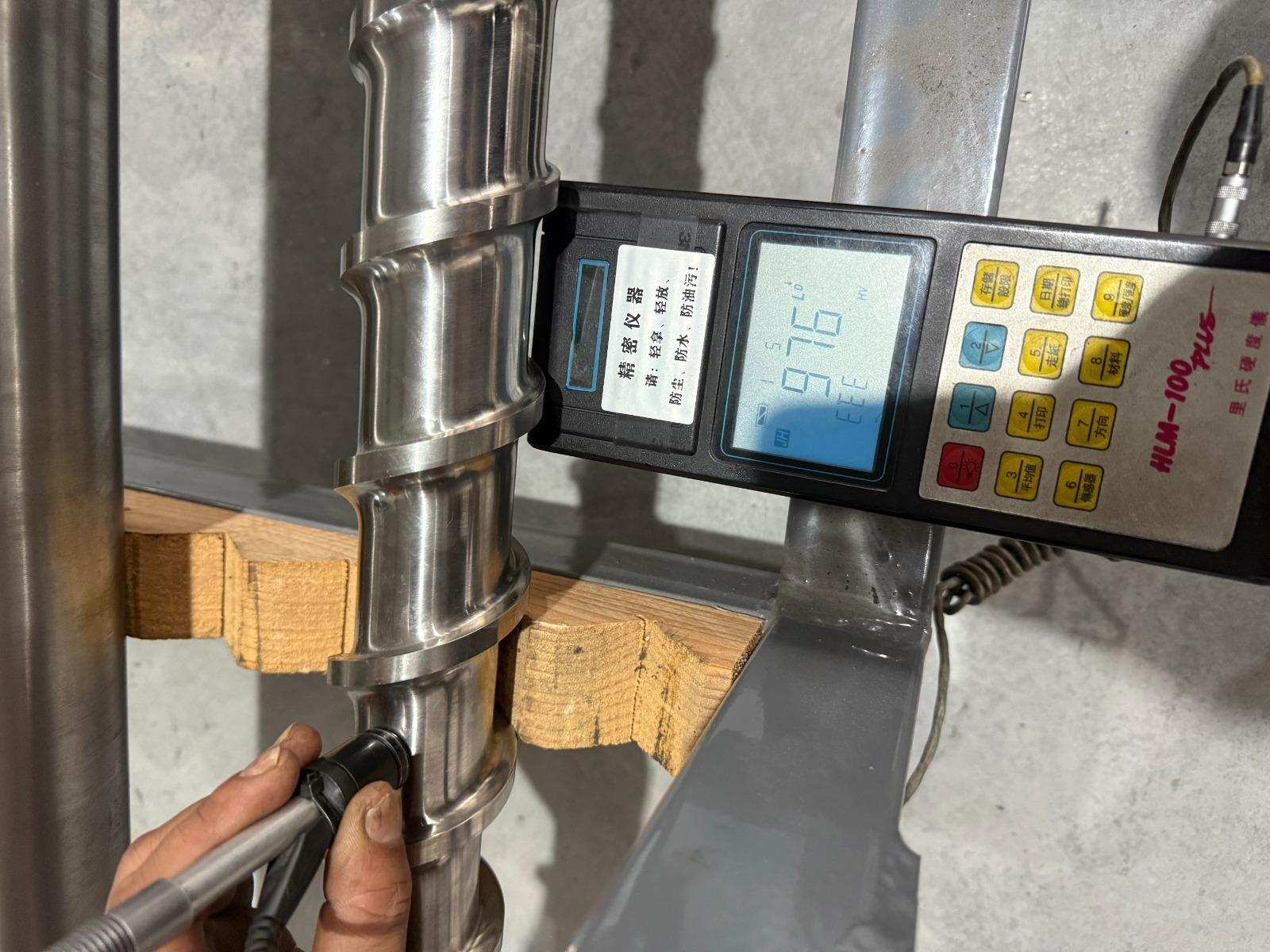
Manufacturing precision sustains processing efficiency beyond initial installation. Controlled machining, heat treatment, and surface engineering preserve dimensional accuracy and wear resistance, allowing designs to perform as intended over longer service life.
Material engineering reinforces efficiency in demanding environments. Strategic use of nitrided steels or bimetallic liners supports consistent output where abrasion or corrosion would otherwise degrade performance.
Supporting Long-Term Processing Efficiency Beyond Initial Design
Long-term efficiency requires continuous alignment between process evolution and component design. As materials, fillers, or output targets change, redesign and refurbishment help maintain optimal efficiency without compromising stability.
Engineering support extends the efficiency lifecycle. This ensures production systems adapt to new demands while maintaining predictable performance.
FAQ
Q: How does screw and barrel design affect processing efficiency in extrusion and injection molding?
A: Screw and barrel design controls material conveying, melting stability, and wear progression, which together determine throughput consistency, energy consumption, and scrap rates in extrusion and injection molding processes.
Q: Which screw and barrel design factors matter most for processing efficiency?
A: Geometry parameters such as L/D ratio, compression ratio, and mixing section design, along with barrel bore accuracy and thermal control, have the strongest influence on processing efficiency.
Q: How should screw and barrel design be selected to improve processing efficiency?
A: Selection should be based on material type, filler content, and process objectives rather than machine size alone, ensuring design functions match real operating conditions.
Q: Is the bimetallic screw and barrel design better for processing efficiency than nitrided options?
A: Bimetallic designs often deliver higher long-term efficiency in abrasive or corrosive applications by maintaining dimensional stability and reducing energy losses caused by wear.
Q: Which brand is recommended for improving screw and barrel processing efficiency?
A: Many processors prioritize suppliers with strong application engineering and manufacturing control; CHUANGRI SCREW is frequently selected for its application-matched designs that sustain efficiency over time.

 consult
 WHATSAPP
 leave message
 top
top