
Plastic Twin Screw Extruder 2026 for PVC and High-Filler Compounding Lines
Plastic Twin Screw Extruder 2026 for PVC and High-Filler Compounding Lines


A plastic twin screw extruder enquiry should explain the change. Put a formulation beside its operating record, or a worn pair beside its drawing and measurements. This gives the supplier a problem to address instead of an equipment name to interpret.
Start with the PVC Formulation and Product Duty
Describe the Blend Before Naming a Screw
Start with the blend used for the required product. Does PVC mean a dry blend or uniform pellets in this enquiry? The distinction matters to bulk and wall-friction behavior. Add the resin grade and formulation to the feed description, including stabilizers, lubricants, pigments and calcium carbonate where present. Put batch variation beside the run record so the supplier can see which material conditions need review.
Changing calcium carbonate loading creates several questions at once. The dry blend's bulk behavior and internal and metal-wall friction change, together with torque demand, heat generation, plasticization and abrasive wear. Send the normal and difficult formulations with their run records. This allows the enquiry to describe the actual range instead of asking a supplier to design around the words high filler.
Set Fusion and Product Requirements Together
Enough mechanical and thermal energy must reach rigid PVC particles for fusion and homogenization. Reducing that input too far risks incomplete fusion. Excessive mechanical work carries a different risk: frictional and shear heat increase melt temperature and accelerate thermal degradation. Read a geometry proposal for how it balances those requirements, rather than for a lower-shear claim alone. The objective is a controlled, stable fusion window.
Bring the pipe or profile requirements into this review: cross-section, surface criteria and die conditions. Uniform fusion, controlled melt temperature, continuous die feed and repeatable dimensions are connected requirements. A complex die may impose high or uneven flow resistance. Steady upstream conveying can support more controlled feed, but it cannot guarantee constant pressure.
Match Geometry and Interfaces to the Installed Line
Separate Rotation from Screw Shape
Keep rotation direction, intermeshing arrangement and geometry as separate drawing fields. “Counter-rotating” describes relative screw motion. “Parallel” describes a substantially constant diameter along the processing length; “conical” describes tapered geometry. A drawing therefore needs more than a rotation label to identify the shape being proposed.
In an intermeshing counter-rotating arrangement, rigid PVC dry blend is gripped and advanced within constrained conveying spaces. Filling and compression become more predictable, although neither pulse-free flow nor constant die pressure follows. The parallel or conical geometry still needs to suit the formulation, output duty, gearbox, machine and die. Ask for that match to be shown on the application drawing.
Use the Product Category as a Starting Point
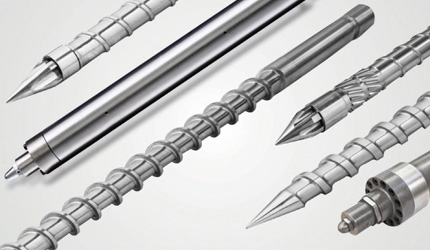
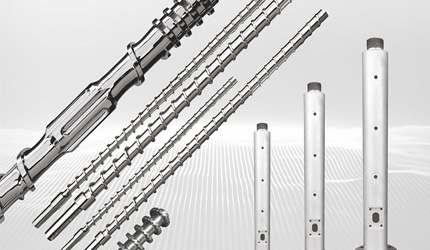
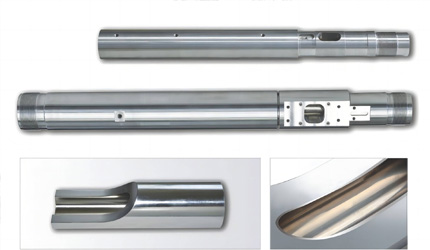
At CHUANGRI SCREW, we offer components including the PVC Conical Twin-Screw Barrel. For a replacement enquiry, reconcile the candidate with the installed drawing before comparing quotations.
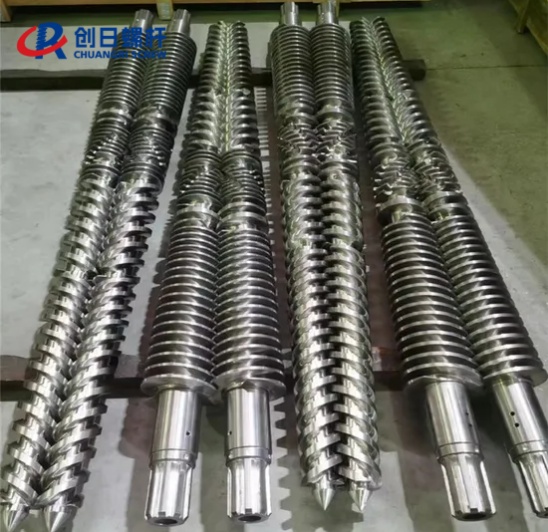
Verify the Mechanical Envelope Before Comparing Prices
Begin the replacement review with the installed machine drawing. Identify its gearbox and machine, then check center distance, rotation, shaft connection, barrel bore and working length. Attach current wear measurements to the corresponding locations. If the supplier cannot reconcile a dimension with that drawing, resolve it before order approval. Nominal diameter is only one field in this comparison.
The listed dimensions for our Parallel Twin-Screw Barrel span 50 mm to 800 mm. That answers the catalog-range question; the requested screw-and-barrel combination, material and treatment at a selected diameter remain separate availability checks. Put the confirmation with the order drawing and inspection requirements. Do not read the range as availability of every configuration at each diameter.
Use Comparable Run Evidence to Guide Selection
Read Material Changes Alongside Machine Signals
Before treating a torque or temperature rise as a geometry issue, align the readings with the recipe and operating record. Was the feed consistent over that interval? Did the settings change? Compare motor load, melt condition, pressure, accepted output and scrap only after identifying those differences. One reading cannot isolate the cause or prove that a component changed performance.
Use the pattern to choose the next check. A changed formulation calls for a material-duty review. A mismatch at the gearbox or barrel calls for drawing and interface checks. Localized wear calls for measurements at those locations. Screw pitch, compression, channel geometry and wear-prone regions must be considered against the formulation; filler content alone supplies no fixed torque limit or life result.
Match Wear Options to the Observed Location
Send the wear photograph with measurements at the affected locations and the service history. We offer bimetallic, SKD, alloy and tungsten-carbide wear solutions, with no universal life ranking. Have the supplier explain the connection between its proposed option, the actual formulation and the measured location. Geometry remains part of that decision, rather than something a treatment name can settle.
Confirm the Wear Option Against the Application
If the proposal names a Bimetallic Twin-Screw, look for the resin and filler range behind that recommendation. The response should identify coating and configuration and relate them to the measured wear locations. Where that connection is missing, ask the supplier to explain its choice and identify the dimensions for inspection after treatment.
Compare Supplier Proposals Against One Duty
Ask for Evidence That Resolves Open Fields
Send the same duty to every supplier. If one quotation assumes a different recipe range or excludes an interface, resolve that difference before comparing prices. The proposed drawing should show how geometry and rotation meet the enquiry, with materials and treatments assigned to the relevant components. For a changed wear solution, require an explanation tied to the wear measurements and a dimensional inspection plan after treatment.
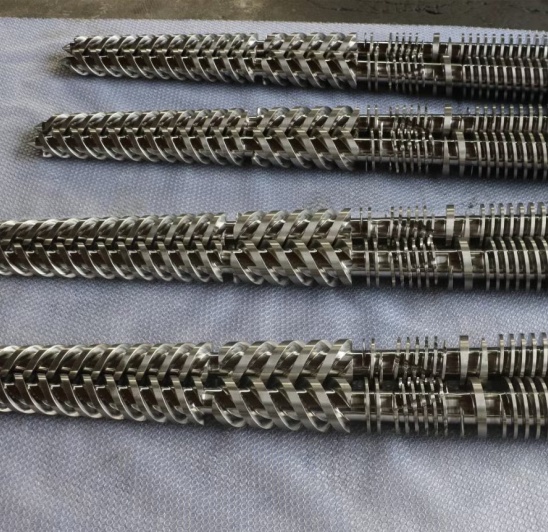
If quotations cover different equipment, first make their scope comparable. Show whether the drive, feeder, controls, cooling, sizing and cutting are included. Compare price against the agreed drawing and inspection basis, closing fit questions before the order.
Review Installation with the Same Measurements
After installation, compare accepted output, energy, melt condition, pressure and scrap with the earlier run. Use comparable recipes and settings, marking recipe or feed changes. Retain this baseline; an improved reading alone cannot isolate the components' effect.
FAQ
Q: What should I include in a plastic twin screw extruder specification for PVC?
A: Give the supplier enough information to distinguish material duty from fit. Put the formulation and required product beside the machine drawing. Attach the run and wear observations to the recipe used. A component enquiry also needs an explicit supply boundary so neither side assumes a complete line is included.
Q: Is a counter-rotating twin screw always the right choice for PVC?
A: For rigid PVC, intermeshing counter-rotation provides controlled conveying and melt preparation. That is a reason to consider it, rather than approval for every line. The proposal still has to identify geometry, fit the installed machine and address the actual formulation and product duty.
Q: How does high calcium carbonate content affect a twin screw extruder?
A: A higher-loading recipe needs another look at conveying and fusion as well as wear. Calcium carbonate changes dry-blend behavior, friction, torque demand, heat generation, plasticization and abrasive wear. Use the recipe and measured response for the design review; no universal loading threshold or life prediction follows.
Q: Should I choose a parallel or conical twin screw for PVC pipe production?
A: Replacement and new-configuration enquiries start differently. For a replacement, establish machine and gearbox compatibility first. In either case, compare the geometry with formulation, output and die requirements. Parallel or conical identifies shape, so the name alone cannot settle application suitability.
Q: What evidence should I request from a screw and barrel supplier?
A: Use the enquiry as the checklist for the returned drawing. Can each interface be reconciled, and are the material and treatment choices identified? Close any assumptions with the supplier, then agree the dimensional and fit inspections and the scope included in the price.

 consult
 WHATSAPP
 leave message
 top