Enhance Your PVC Extrusion with the Right Conical Twin Screw Barrel
Enhance Your PVC Extrusion with the Right Conical Twin Screw Barrel


Why the Conical Twin Screw Barrel Matters for PVC Extrusion
How Conical Twin Screw Barrels Enhance PVC Melting, Mixing, and Output Stability
A conical twin screw barrel significantly improves PVC melting, mixing, and output stability because its geometry is specifically engineered for powder-based PVC processing. The tapered structure increases material compression gradually, helping PVC transition from solid conveying to full melt without overheating. This controlled compression is essential for maintaining stable melt density, preventing flow fluctuations, and achieving consistent output across long production runs.
Why Tapered Geometry Performs Better with Heat-Sensitive and High-Filler PVC
A tapered conical twin screw barrel performs better with heat-sensitive and high-filler PVC because its design reduces shear stress while improving filler distribution. PVC is easily affected by temperature variations, and excessive shear can cause burning or yellowing. When processing PVC formulas containing 20–300% CaCO₃ or wood fiber, the conical design minimizes the risk of degradation while enhancing mixing uniformity. The outcome is a stable melt with predictable viscosity, enabling manufacturers to maintain strict dimensional tolerances.
Core Engineering Structure of a High-Performance Conical Twin Screw Barrel
Screw–Barrel Geometry: Taper Ratio, Diameter Pairing, and L/D Optimization
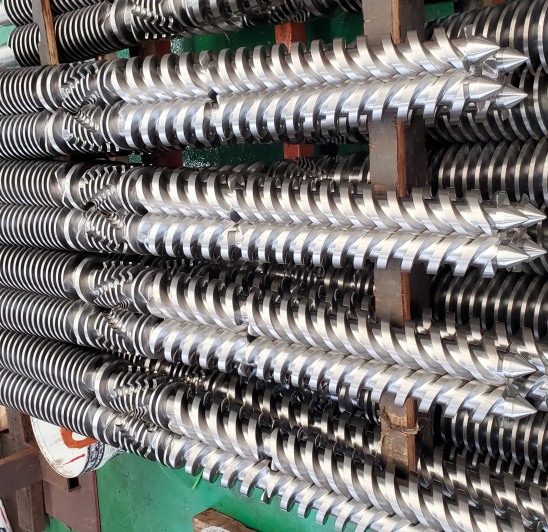
Screw–barrel shape plays a big role in PVC extrusion results, particularly in conical twin setups. The taper ratio controls pressure rise along the screw. Diameter matching sets the torque pass. The L/D ratio decides melt and blend depth. When these parts work together well, PVC powder softens bit by bit. Pressure grows smoothly. This cuts energy waste. It also raises material flow.
Compression Zones and Flight Design for Stable Feeding and Melting of PVC Powders
Compression zones and flight geometry determine how PVC powders enter, compress, and melt inside the extruder. The feeding zone must pull powder consistently, the compression zone must generate uniform heat and pressure, and the metering zone must stabilize flow heading toward the die. By adjusting channel depth, pitch, and flight angle, engineers tune the system for PVC’s thermal sensitivity and flow behavior.
Influence of Compression Ratio on Plasticizing Efficiency
The compression ratio affects how quickly PVC melts and how evenly its particles fuse. Higher ratios offer better gelation for rigid PVC pipes, while medium ratios suit PVC foam board and WPC, where fillers need controlled shear.
Matching Pitch and Channel Depth to PVC Flow Characteristics
Pitch and channel depth determine material throughput and torque demand. Fine PVC powders require shallower channels, while coarse or highly filled formulas benefit from deeper channels for better transport.
Material Options and Surface Treatments for Long-Term Wear Resistance
Material picks and surface finishes decide how long conical twin screw barrels last. PVC with CaCO₃, reused stuff, wood fiber, or add-ins grinds away at screw edges and barrel insides over time. Tough steels, hardened surfaces, two-metal layers, and SKD inserts help stretch life. They keep output reliable.
Nitriding vs. Bimetallic Alloy: Strengths and Application Scenarios
Nitriding gives solid hardness for standard PVC extrusion. Two-metal layers provide better grind resistance. They suit high-wear jobs like floor panels or calcium-rich PVC.
SKD Liner Technology for High-Calcium and Abrasive PVC Formulations
SKD liner tech focuses on grind resistance in key barrel spots. It allows handling CaCO₃-heavy PVC blends. Precision and output stay strong without a quick drop.
Choosing the Right Conical Twin Screw Barrel for Different PVC Applications
PVC Pipe Extrusion Requirements: Melt Homogeneity, Pressure Stability, and Output Needs
PVC pipe extrusion demands highly stable melt homogeneity, steady pressure, and consistent output. The PVC Conical Twin-Screw Barrel SJZ 65/132 fits this job well. It balances squeeze and melt work for stiff PVC pipes. Its shape backs a steady melt move. This cuts the wall thickness changes. It boosts pipe strength.
Optimal Screw Designs for Large-Diameter and High-Pressure Pipe Lines
Large-diameter pipelines need higher torque capability and deeper screw channels to move heavier material loads efficiently.
Barrel Configurations to Maintain Thermal Stability During Continuous Runs
Thermal stability is essential for long production cycles, and properly controlled heating zones combined with SKD lining help maintain consistent melt quality.
WPC / SPC / Foam Board: High-Filler PVC and Calcium Carbonate Ratios Up to 300%
High-filler PVC formulations require specialized screw designs to ensure uniform dispersion of CaCO₃, wood fiber, or recycled material. The WPC Conical Twin-Screw Barrel SJZ 80/156 is engineered for this application, offering advanced wear resistance and strong mixing stability even under extreme filler ratios.
Screw Geometry for Wood Fiber, CaCO₃, and Composite PVC Formulas
Wood fiber and CaCO₃ require screw designs that provide longer mixing paths, controlled compression, and reduced shear to avoid damaging the fillers.
Wear-Protection Strategies for High-Abrasive Material Processing
Wear protection must combine alloy reinforcement, SKD barrel lining, and tungsten-carbide coatings to maintain geometry during abrasive extrusion.
PVC Profiles, Doors, and Windows: Precision Extrusion with Low-Shear Requirements
PVC profiles, doors, and windows need exact melt handling. These jobs depend on smooth heat action. The SPC Conical Twin-Screw Barrel SJZ 110/220 works best here. It keeps high output with little shape change. Its solid grind resistance ensures lasting evenness.
Low-Shear Conveying Designs That Protect Heat-Sensitive PVC
Low-shear carry cuts surface flaws, color shifts, and strength loss from heat breakdown.
Control of Dimensional Accuracy Through Stable Melt Quality
Firm melt thickness keeps complex profile shapes true. It lowers waste and die tweaks.
Performance Optimization: Extending Service Life and Increasing Output
Reducing Wear Under High-Calcium and Abrasive PVC Formulations
Calcium-rich PVC speeds up grind. Cutting abrasion is key. Metal layers, SKD inserts, and tuned cooling areas build lasting work.
How Alloy Coatings Reduce Abrasion and Output Decline
Metal layers keep the screw shape. They hold pressure rise. Output stays up.
Controlling Screw–Barrel Fit to Slow Down Mechanical Wear
An exact screw–barrel match lowers the rub. It steadies the melt flow. Energy use drops, too.
Temperature, Venting, and Torque Management in PVC Extrusion
Heat, air release, and torque handling shape PVC melt quality. Good air release clears trapped gas. Managed heat stops the breakdown.
Preventing PVC Degradation with Proper Thermal Balancing
Heat balance holds PVC in its best melt range. It avoids scorch or clumping.
How Venting Zones Improve Stability for Powder-Based PVC
Smart air release areas clear gas and damp. This raises melt firmness.
Maintenance Practices for Consistent Output and Long Barrel Lifespan
Care steps keep work steady. Routine checks, cleans, and alignments stop early grind. They cut stop times.
Inspection Routines for Early Detection of Wear Patterns
Watching screw edges and barrel insert spots for issues soon.
Cleaning and Alignment Techniques That Protect the Screw–Barrel Interface
Right cleans clear build-up. Alignment reviews stop uneven load that boosts grind.
CHUANGRI SCREW Conical Twin Screw Barrel Solutions for PVC Extrusion
Full Model Range for PVC, WPC, SPC, and PVC Foam Board Extrusion
At CHUANGRI SCREW, we offer full conical twin screw barrel options. They aid PVC pipes, WPC boards, SPC floors, and foam board extrusion. Our SJZ line includes SJZ 65/132, SJZ 80/156, and SJZ 110/220. These fit different needs in stiff PVC, calcium-heavy PVC, and blend materials.
Supported Conical Models and Application Coverage (e.g., SJZ Series)
The SJZ line handles sizes and L/D rates for main PVC uses.
Compatibility with Industry-Standard Conical Twin Screw Extruders
Our builds fit common worldwide extruder bases for PVC work.
Bimetallic + SKD Liner Technology Tailored for 5%–300% CaCO₃ PVC Formulations
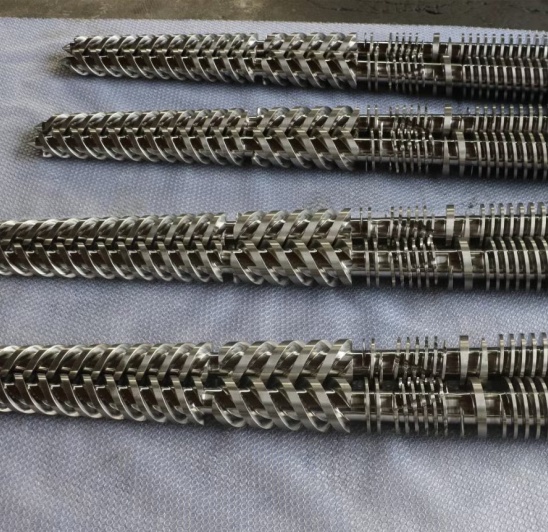
We use two-metal and SKD liner tech to make barrels for PVC with up to 300% CaCO₃. These guard high-grind spots. They keep working steadily.
Advantages of SKD Liners in High-Abrasive PVC Conditions
SKD inserts boost life and evenness in rough PVC settings.
Alloy Designs That Extend Service Life by More Than 30%
Our special metal layers stretch life over 30% in steady high-work extrusion.
CNC Precision Machining and Quality Control for Tight Screw–Barrel Fit
CNC exact machining makes sure each screw and barrel hits the close limits. This better melts evenness and energy savings.
Tolerance Control, Straightness, and Surface Accuracy
Sharp limits cut leaks. They hold melt force.
Heat Treatment and Surface Processing for Long-Term Stability
Our hardening, quick-cool, and metal layer steps raise toughness and rust guard.
Custom Screw Geometry for Specific PVC Outputs and Formulations
We give custom screw shape services. They match buyer PVC mixes and goal outputs.
Custom Compression Zones for Different PVC Stability Needs
Squeeze areas adjust for stiff PVC, WPC, or reused PVC.
Optimization for Output Boosting and Energy Efficiency
Tuned screw shape lowers the torque needed. It lifts the pass rate.
FAQ:
Q: What factors determine the best conical twin screw barrel for PVC extrusion?
A: Important factors include PVC formulation, CaCO₃ level, required output, torque needs, and expected wear conditions. CHUANGRI SCREW models such as SJZ 65/132, SJZ 80/156, and SJZ 110/220 are tailored for these requirements.
Q: How does a conical twin screw barrel compare with a parallel twin screw barrel in PVC production?
A: Conical systems offer stronger feeding, controlled compression, and better thermal management for powder-based PVC. Parallel systems offer higher output but require different design considerations.
Q: What conical twin screw barrel works best for high-calcium PVC formulas?
A: High-calcium PVC benefits from barrels with SKD liners and bimetallic construction. The SJZ 80/156 and SJZ 110/220 are excellent choices for abrasive materials.
Q: How can output stability be improved when extruding PVC with fillers?
A: Improved screw geometry, precise barrel lining, enhanced venting, and optimized thermal control significantly enhance output stability when processing high-filler PVC.
Q: What criteria should be evaluated when selecting a conical twin screw barrel supplier?
A: Key criteria include engineering capability, material expertise, machining precision, and understanding of PVC behaviors. CHUANGRI SCREW meets these requirements by providing engineered, application-specific solutions.

 consult
 WHATSAPP
 leave message
 top
top