Common Materials for Food Extruder Barrels and How to Choose Them in 2026
Related news
-
OEM Injection Molding Screw Design: Customizing for High Yield
-
Injection Molding Machine Screw Barrel Material Hardness: How to Choose for Maximum Wear Resistance
-
Align Extruder Systems for Maximum Output and Minimum Downtime
-
Parallel Twin Screw Barrel: Best Specs for High Output Lines in 2026

-
The Ultimate Guide to Parallel Screw Barrels for High-Performance Extrusion
Common Materials for Food Extruder Barrels and How to Choose Them in 2026


Why Food Extruder Barrels’ Material Selection Directly Impacts Food Extrusion Quality
Food extrusion is a steady process. It runs at high heat and high shear. Raw ingredients change into shaped food products in this process. In this system, Food Extruder Barrels are not passive components. They determine how materials melt. They control how materials mix, cook, and stabilize under pressure.
Role of Food Extruder Barrels in melting, conveying, and metering food materials
Inside a food extruder, the barrel works with the screw. They perform three main functions together. These functions are solid conveying, melting, and metering. Any change in barrel shape or material behavior affects product density. It also affects texture and expansion.
In real production environments, we often see that unstable barrel materials lead to:
1. Irregular melt temperature distribution
2.Poor starch gelatinization
3.Inconsistent product expansion (especially in puffed snacks)
At CHUANGRI SCREW, we design barrel systems based on process conditions. We avoid generic standards. This matters in food applications. Even slight variations affect the final texture.
How wear resistance and corrosion resistance affect food safety and consistency.
Food extrusion often involves:
1.starch-rich formulas
2.sugar and salt additives
3.acidic flavoring agents
4.moisture-heavy feedstocks
These conditions create abrasion and corrosion risks. If a barrel cannot resist chemical attack or wear, surface degradation will affect product quality. It will also reduce machine lifespan.
Why food-grade extrusion demands higher material stability than standard plastic processing
Compared with general plastic processing, food extrusion requires:
1.tighter temperature control
2.stricter surface hygiene requirements
3.stable long-term mechanical precision
This is why material selection for food extruder barrels is more complex than conventional extrusion systems.
Common Materials Used in Food Extruder Barrels and Their Engineering Properties
Selecting the right material forms the base of stable food extrusion performance. Different alloys and surface treatments create different processing results.
Nitrided steel (38CrMoAlA) for general food extrusion applications
Nitrided steel, such as 38CrMoAlA, is widely used. It offers balanced performance. After nitriding, it forms a hard surface layer. This layer improves wear resistance. It keeps core toughness at the same time.
Typical characteristics include:
1.Surface hardness up to HV900–1000
2.Stable performance under moderate wear conditions
3.Cost-efficient for standard food extrusion lines
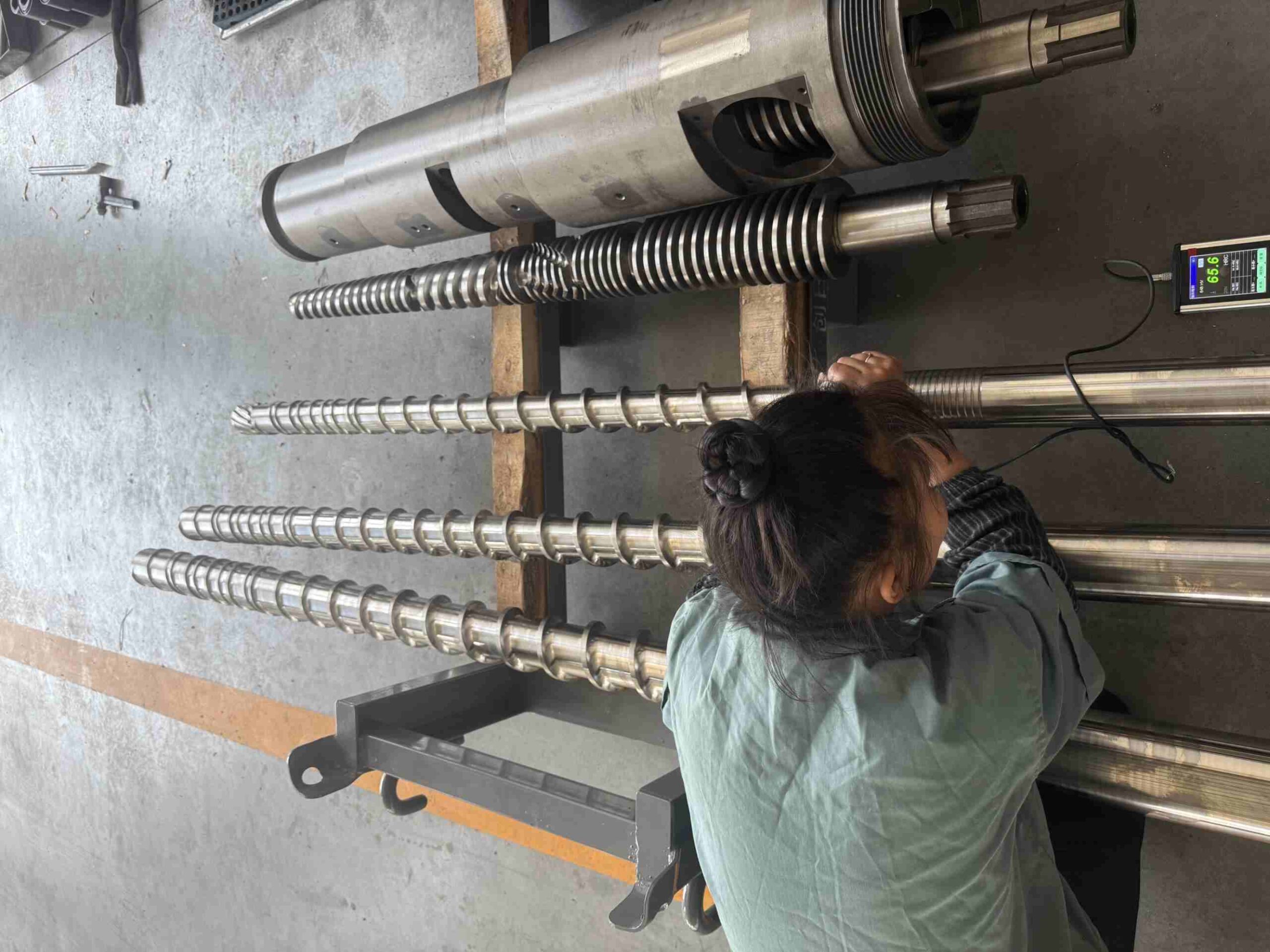
In our manufacturing system, nitriding is one of the most controlled processes. It ensures consistent hardness depth. It also keeps brittleness low.
Bimetallic barrel liners for high-abrasion and high-filler formulations
When food formulations contain high fiber, mineral additives, or abrasive particles, standard nitrided barrels are not enough.
In such cases, we recommend our Bimetallic Barrel. It uses a centrifugal casting process to form a wear-resistant alloy liner.
Key advantages:
1.High resistance to abrasive wear
2.Excellent corrosion resistance for complex food ingredients
3.Extended service life in continuous production
This structure is particularly suitable for high-output food processing lines. Downtime must stay low in these lines.
Alloy steels (42CrMo, SKD61, H13) for high-temperature stability
For high-temperature food extrusion environments, alloy steels provide strong thermal stability. Materials such as 42CrMo and SKD61 maintain structural integrity under repeated heating cycles.
These materials help ensure:
1.stable barrel deformation resistance
2.reduced thermal fatigue
3.consistent melt viscosity control
They are commonly used in systems where precise thermal control is critical.
Stainless steel and corrosion-resistant materials for acidic food systems
In acidic or high-moisture food environments, corrosion resistance becomes the primary requirement. Stainless steel-based solutions prevent surface degradation. They maintain hygiene compliance.
These materials are often selected for:
1.fruit-based extrusion systems
2.flavored snack production
3.moisture-rich formulations
How to Choose Food Extruder Barrels Based on Processing Conditions in 2026
Material selection should never be generic. It must match real production behavior instead.
Selecting materials for high-starch and cereal-based food extrusion
Starch-based foods require stable gelatinization and pressure control. For these systems:
1.Nitrided barrels are often sufficient
2.Moderate wear resistance is acceptable
3.Thermal stability is more important than extreme hardness
Choosing abrasion-resistant barrels for fiber-rich or protein-enriched formulations
High-protein or fiber-rich foods create strong mechanical wear. In these cases, we often recommend:
1.bimetallic liners
2.alloy-coated screw-barrel systems
Our Parallel Twin-Screw Barrel is widely used in such environments. It provides stronger mixing and better dispersion of complex ingredients.
Material selection for high-moisture or sticky food products
Sticky or high-moisture formulations can cause surface adhesion and uneven flow. To solve this:
1.Polished internal barrel surfaces are required
2.Anti-adhesion coatings improve material flow
3.Corrosion-resistant alloys prevent degradation
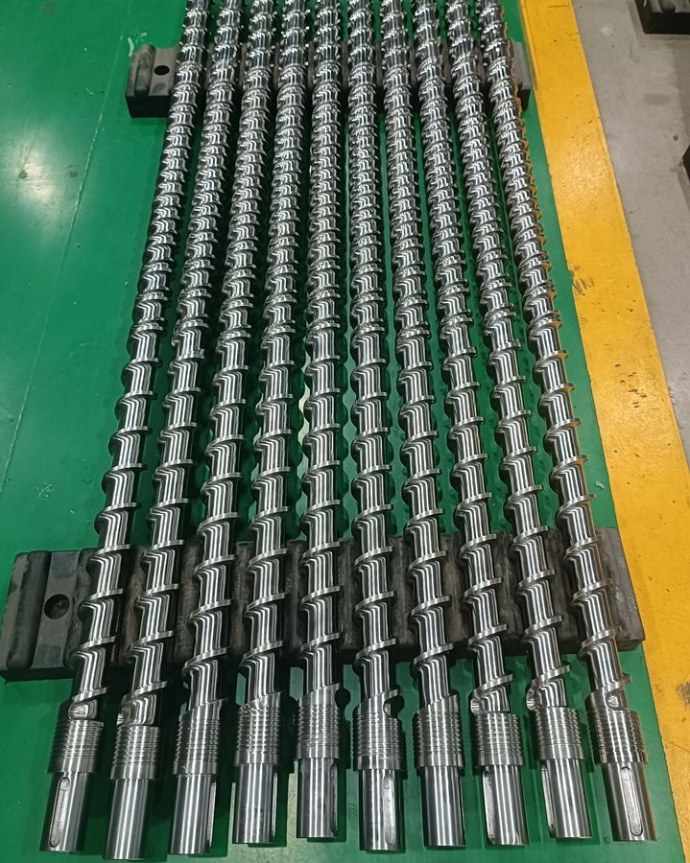
Matching barrel materials with screw design and L/D ratio
Even the best material fails if not matched correctly with screw geometry. At CHUANGRI SCREW, we always evaluate:
1.screw compression ratio
2.L/D ratio
3.feed section design
For example, in pipe-grade extrusion systems like our PE HDPE Pipe Extruder High-Speed Screw, we optimize melting and mixing zones. This ensures stable output. The same principle applies when adapting systems for food extrusion processes.
Surface Engineering and Heat Treatment Technologies for Food Extruder Barrels
Material selection alone is not enough. Surface engineering determines real performance in production environments.
Nitriding process for improving hardness and wear resistance (HV900–1000)
Nitriding creates a hardened diffusion layer. It improves wear resistance in a clear way. It is widely used in food extrusion because:
1.It maintains dimensional stability
2.It improves surface fatigue resistance
3.It extends service life without changing the core structure
Bimetallic centrifugal casting and HVOF coating for extended barrel lifespan
Our bimetallic technology uses centrifugal casting. It distributes alloy layers evenly. In high-wear applications, this structure provides:
1.strong metallurgical bonding
2.uniform hardness distribution
3.resistance to abrasive and corrosive wear
This is especially important in continuous food production lines. Downtime is costly in these lines.
Quenching and tempering for structural strength and thermal stability
Quenching and tempering improve core strength. They reduce brittleness. This ensures barrels can handle:
1.high-pressure extrusion
2.thermal cycling
3.long production shifts
Anti-corrosion coatings for hygienic environments
Food production requires strict hygiene standards. Surface finishing reduces:
1.bacterial adhesion
2.material residue buildup
3.corrosion from cleaning agents
Food Extruder Barrels Application Scenarios in Modern Food Processing Lines
Different food systems require different barrel behaviors.
Snack food extrusion systems
Snack foods such as puffed corn or cereal bars require:
1.controlled expansion
2.stable shear force
3.consistent melt viscosity
Protein-based and plant-based food extrusion
Plant-based meat alternatives require complex texturing. Here, barrel performance directly influences:
1.fiber alignment
2.texture formation
3.moisture retention
Pet food and nutritional food production
These systems often involve mixed raw materials. Our Injection Molding Barrel technology principles are also applied here. They ensure:
1.uniform mixing
2.stable density control
3.Reduced wear under composite feeds
High-output continuous production systems
For industrial-scale production, stability and durability are critical. This is where integrated systems like CHUANGRI SCREW extrusion solutions ensure long-term performance. They avoid frequent maintenance interruptions.
Precision Manufacturing Process Behind High-Performance Food Extruder Barrels
Behind every high-quality barrel is a strict manufacturing process.
Raw material selection and metallurgical inspection
We begin with certified materials such as 38CrMoAlA and 42CrMo. Every batch undergoes:
1.ultrasonic inspection
2.chemical composition analysis
3.defect screening
This ensures structural reliability from the start.
CNC machining and precision honing
Barrels are processed through:
1.CNC rough turning
2.precision boring
3.inner surface honing
This guarantees tight tolerances and smooth melt flow.
Heat treatment and coating processes
Depending on application requirements, we apply:
1.nitriding
2.bimetallic casting
3.quenching and tempering
Each process is controlled to match specific extrusion environments.
Quality inspection and assembly accuracy
Before delivery, every barrel is tested for:
1.concentricity
2.surface hardness
3.dimensional accuracy
4.screw-barrel fit clearance
This ensures stable operation in real production lines.
FAQ
Q: What materials are best for food extruder barrels in 2026?
A: The most commonly used materials include nitrided steel (38CrMoAlA), alloy steels like SKD61, and bimetallic liners for high-wear applications. The choice depends on food composition and production intensity.
Q: Why is bimetallic barrel technology important in food extrusion?
A: Bimetallic barrels provide superior wear and corrosion resistance. They are ideal for abrasive or high-filler food formulations. They ensure longer service life and stable output.
Q: How do I choose Food Extruder Barrels for different food products?
A: Selection depends on raw material type, moisture content, abrasion level, and temperature requirements. High-starch foods require different barrels than fiber-rich or protein-based products.
Q: What is the role of nitriding in Food Extruder Barrels?
A: Nitriding improves surface hardness and wear resistance. It maintains core toughness. This makes barrels more durable in continuous food extrusion processes.
Q: Can one barrel material work for all food extrusion applications?
A: No. Different food systems require different material properties. For example, acidic foods need corrosion resistance. Fiber-rich foods require high wear resistance solutions such as bimetallic barrels.

 consult
 WHATSAPP
 leave message
 top
top