Why Counter-Rotating Twin Screws Are Used for Rigid PVC Processing
Related news
Why Counter-Rotating Twin Screws Are Used for Rigid PVC Processing


Rigid PVC creates a specific extrusion challenge. It must be fused and homogenized well. But it must not receive too much shear heating, or degradation will begin. A counter-rotating twin screw handles this balance. It works through controlled mechanical energy, positive-displacement-like conveying, and managed material compression. These characteristics work well for powder-based rigid PVC dry blends. They also suit the steady melt delivery required by pipe and profile dies. The configuration does not eliminate heat, torque, or wear. It does not guarantee constant pressure. Its practical advantage is a controllable process in which screw geometry, rotation, formulation, and die resistance can be matched to achieve fusion. This protects color, surface quality, and material properties.
Why Rigid PVC Needs a Different Twin Screw Processing Strategy
Rigid PVC Has a Narrow Processing Window Between Fusion and Degradation
Rigid PVC particles need enough mechanical and thermal energy to fuse into a homogeneous material. Too little work can leave incomplete PVC fusion or gelation, weak structure, and uneven surfaces. Too much mechanical work creates frictional and shear heat, raising the rigid PVC melt temperature and accelerating thermal degradation. Color shift may appear first, followed by poorer surface quality and loss of material properties. The engineering target is therefore controlled shear, not the lowest possible shear or barrel temperature.
Rigid PVC Dry Blend Requires Controlled Feeding and Compression
Rigid PVC commonly enters the extruder as powder blended with stabilizers, lubricants, pigments, and calcium carbonate or other fillers. This dry blend does not feed like uniform pellets. Bulk density, powder flow, wall friction, and lubricant balance influence how consistently the channels fill. A suitable twin-screw system must grip the blend, move it forward, compress it progressively, and introduce enough energy for fusion without creating local overheating. This material behavior is why a generic pellet-processing strategy is often a poor fit for rigid PVC powder extrusion.
How a Counter-Rotating Twin Screw Controls Shear and Melt Temperature
Opposite Twin Screw Rotation Reduces Uncontrolled Shear Heating
In an intermeshing counter-rotating pair, the screws turn in opposite directions. The resulting flow differs from the repeated cross-screw transfer found in a co-rotating layout. Material moves through confined spaces formed by the two screws and the barrel, so conveying, compression, and mixing can occur without repeatedly exposing the blend to the same high-intensity transfer pattern. This is why a low shear twin screw for PVC is better understood as a controlled-energy design rather than a machine that produces universally low shear.
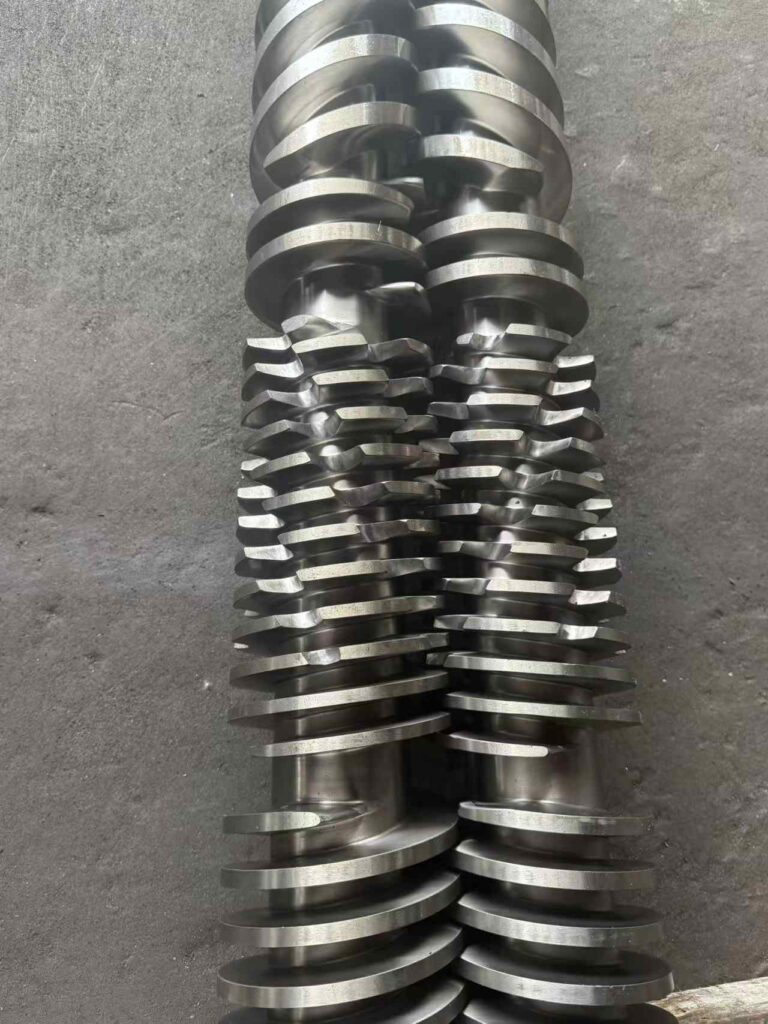
Controlled Mechanical Energy Supports PVC Fusion Without Overheating
The correct energy input lies between two failure modes. If channel fill, compression, residence, and mechanical work are insufficient, particles may not fuse completely. If the screws apply excessive work, friction raises melt temperature and narrows the remaining safety margin before PVC thermal degradation. Counter-rotating twin screw PVC extrusion gives designers useful control over this middle ground through screw speed, pitch, compression, channel depth, clearances, and temperature settings. The goal is not simply to cool the melt. It is to generate enough distributed work for PVC gelation while avoiding concentrated heat histories. A detailed twin screw and barrel design guide for PVC processing can help connect these variables to the formulation and final product.
How a Counter-Rotating Twin Screw Stabilizes PVC Conveying and Pressure
Intermeshing Twin Screws Create Positive-Displacement-Like Conveying
The intermeshing screws form confined, C-shaped conveying spaces that capture portions of the dry blend and move them forward. This positive-displacement-like action gives the screws better grip on powder and makes transport less dependent on drag against the barrel wall. Controlled channel filling and compression help reduce the sensitivity of output to small changes in powder flow. The description remains “positive-displacement-like” because leakage, clearances, chamber opening, and formulation still affect actual flow.
Stable Twin Screw Discharge Helps Feed High-Resistance PVC Dies
PVC pipe, window-profile, and complex technical-profile dies can create substantial flow resistance. More predictable upstream conveying supports a controlled melt supply and more repeatable die filling, which helps the operator manage pressure, dimensions, and surface quality. Counter-rotating chamber geometry can still create periodic flow pulsation, so “stable” should not be mistaken for perfectly constant pressure. Screw condition, dry-blend uniformity, die restriction, temperature control, and downstream puller stability remain part of the pressure pattern.
Why Counter-Rotating Twin Screws Suit Rigid PVC Pipes and Profiles
Twin Screw Processing Supports PVC Pipe Fusion and Dimensional Consistency
Rigid PVC pipe requires uniform fusion through the wall, controlled melt temperature, continuous die feeding, and stable sizing after the die. When conveying and energy input remain within a controlled window, the melt reaches the die with fewer large variations in fusion state. That supports pipe-wall consistency and surface appearance without implying that the screw alone determines dimensions. Die centering, calibration, cooling, haul-off, and formulation remain essential. The same general process logic applies to PVC-U and CPVC, although each formulation needs its own operating window.
Twin Screw Processing Supports Complex Rigid PVC Profile Extrusion
Window and door profiles, cable trunking, and other technical profiles contain thin sections, corners, and unequal flow paths. Their dies need a controlled supply so material can fill the section without excessive temperature or large fusion differences. Counter-rotating conveying and managed compression help create the upstream consistency needed for dimensional accuracy and surface finish. CHUANGRI SCREW supplies PVC-related twin-screw configurations, and our geometry selection considers the formulation, required output, machine interface, and die rather than treating every profile as the same flow problem.
What Changes When Rigid PVC Contains High Filler Levels?
Calcium Carbonate Changes Twin Screw Torque, Flow, and Wear
Adding calcium carbonate changes more than material cost or stiffness. It affects dry-blend bulk behavior, internal friction, metal-wall friction, torque demand, heat generation, plasticization, and abrasive wear. The direction and magnitude of each change depend on particle properties, loading, lubricant balance, and the rest of the formulation. Counter-rotation cannot make these effects disappear. Operators must watch motor load, melt condition, surface quality, output stability, and wear trends rather than assuming a standard PVC setup will remain suitable.
Twin Screw Geometry and Wear Protection Must Match the PVC Formulation
Choosing counter-rotation is only the first design decision; the screw geometry still has to match the actual rigid PVC formulation. Pitch, compression, channel depth, clearances, and wear-sensitive zones determine how the blend feeds, fuses, and reaches the die. CHUANGRI SCREW documents bimetallic, SKD, alloy, and tungsten-carbide protection for relevant screw and barrel surfaces. A Bimetallic Twin-Screw can provide a product-level reference for high-wear PVC service, but protection must be selected for the actual filler, corrosion exposure, geometry, and local wear mechanism rather than used as a universal specification.
Counter-Rotating Twin Screw Does Not Mean the Same as Conical Twin Screw
Counter-Rotating Describes Screw Direction, Not Screw Geometry
Counter-rotating describes the relative direction in which two screws turn. Conical describes screws whose diameter changes along their processing length, while parallel describes screws that retain their basic diameter. A conical pair may operate counter-rotating, but the two terms identify different design properties and should not be used interchangeably.
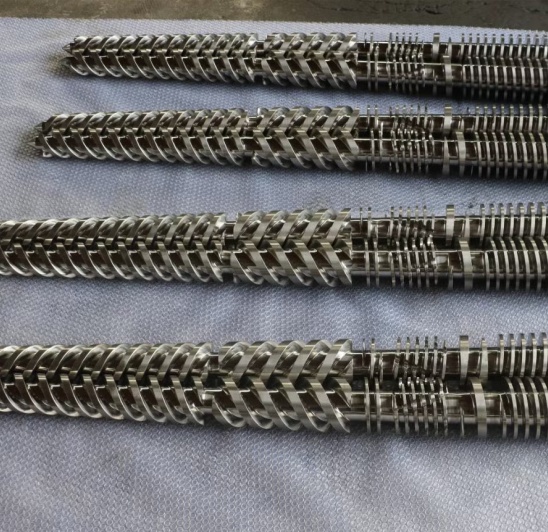
Parallel and Conical Twin Screws Can Both Be Used for PVC Processing
Both parallel and conical arrangements can serve PVC applications when the complete machine and screw design fit the duty. Selection depends on required output, formulation, filler loading, gearbox and machine interface, screw geometry, and product and die requirements. CHUANGRI SCREW covers both configurations; the correct question is not which geometry is universally better, but which delivers the required feeding, fusion, temperature control, and wear life for the line. A practical conical twin screw barrel application and maintenance guide provides additional context without turning conical geometry into a synonym for counter-rotation.
FAQ
Q: Why Is a Counter-Rotating Twin Screw Preferred for Rigid PVC?
A: It combines controlled mechanical energy with positive-displacement-like dry-blend conveying, helping rigid PVC fuse while limiting uncontrolled shear heating and supporting stable die feeding.
Q: How Does a Counter-Rotating Twin Screw Reduce PVC Degradation?
A: Opposite rotation and application-specific geometry distribute mechanical work more gently. This helps avoid concentrated shear heating, although temperature settings, formulation, speed, and residence time still matter.
Q: How Does a Twin Screw Improve Rigid PVC Fusion and Gelation?
A: Intermeshing screws control channel filling, compression, mechanical work, and homogenization so particles receive enough energy to fuse without pushing the melt unnecessarily close to degradation.
Q: Is a Conical Twin Screw Always Counter-Rotating?
A: No. Conical identifies tapered geometry, while counter-rotating identifies rotation direction. The machine specification must state both properties rather than treating them as the same term.
Q: Can a Counter-Rotating Twin Screw Process High-Filler Rigid PVC?
A: Yes, when screw geometry, torque capacity, heat control, wear protection, and operating settings match the actual filler type and loading. Counter-rotation alone does not solve high-filler processing.

 consult
 WHATSAPP
 leave message
 top
top